Showing posts with label VS. Show all posts

Sunday, October 24, 2010

Tribute to the passing of a Giant of a Man, Captain Tony Schneider

A friend back in Albuquerque called to tell me about the passing of a true hero who had a profound impact on my life. Here is the obit as it ran in the Albuquerque Journal:

SCHNEIDER -- Tony Schneider, 92, passed away October 16, 2010. Those who wish to express condolences may do so at: www.danielsfuneral.com Tony's care has been entrusted to: Daniels Family Funeral Services 7601 Wyoming Blvd, NE Albuquerque, NM 87109 (505) 821-0010

Plain and simple it hides a huge Man and true hero, recalled to active duty in God’s own Navy.

Let me explain. I knew him as Captain TF Schneider, Naval Science Instructor. For three years he was one of two men in my High School Junior ROTC program that were Naval Science Instructors. The one was a crusty Senior Chief that came out of Submarines (SSBN’s). He was our “Military” instructor and taught us infantry drill, marching and standing in formation. We actually carried old rifles (1903 Springfield’s with lead poured down the bore) which today would make todays Public School Administrators crap their pants. But the Senior Chief was good for a cup of coffee and great modern sea stories.

That's me in the middle of the top row, circa 1973.

The real “Naval Science” was taught by the Captain. An unassuming man who preached to us Naval History, Sea Power and seamanship of all things, way out in the desert west of Albuquerque. But preach he did, three days a week we took his lectures; the other two day’s were given up to the Senior Chief. We saw everyone of the Victory at Sea movies, the good Captain had lectures designed around each episode. He was a former Naval Aviator and the oldest sea story we ever got out of him went all the way back to the day Pearl Harbor was bombed by the Japanese. He was assigned to the USS Enterprise and flew his first combat air patrol on that day, searching for the Japanese fleet.

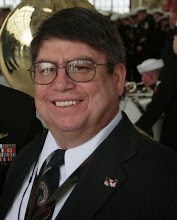
This is the Captain as I remember him, always the teacher, always the role model. Couldn't have asked for better.

After graduation I was one of the many that joined the Navy right out of High School. I was more than prepared thanks to both the Captain and the Senior Chief. After maybe 4 or 5 weeks into Basic training I was sent off to take the Basic Test Battery to determine what kind of school or job specialty I was to get as I was at that point in time undesignated. Once the scores came back I was sent again to see the Career Councilor to pick that Rating and to fill out my “Dream sheet” as it’s called. This is the list of preferred duty stations.

I had high test scores and was told I could go into any job the Navy had. So, I did some figuring. I wanted aviation; I wanted to work on the flight deck of an Aircraft Carrier. But deep in my mind the gears were turning. I remembered the lessons taught by that unassuming Captain. The Big lesson he taught was of how in two consecutive World War’s, the Free world had been brought to its knees because of Submarines.

But, deeper inside was a more subtle lesson, that Anti-Submarine Warfare (or ASW) had turned back the Submarine menace and allowed not just the Naval Forces free reign on the oceans but the commercial shipping which in both war’s allowed beleaguered nations to continue the Fight.

It was also the lack of any ASW that gave our Navy’s submarines free reign in the Pacific. A force that represented only 2% of the entire Navy accounted for 55% of Japan’s maritime losses (from “Silent Victory” by Clay Blair, Jr.). An astonishing figure that was allowed because Japan fielded only a token ASW force.

So it was ASW for me and in Naval Aviation there were only two ratings that were supposed to be devoted to ASW, AX and AW. The first of these is the Electronics Technician that specialized in ASW equipment, the latter is Operator of ASW equipment, he flies in the aircraft. The former worked the Flight Deck.

I filled out the various paper work requesting the AX as first priority and AW as the second. Of course the Career Councilor laughed at me saying that both schools took months to get into, the waiting list was 6-months long. He prepared me for the Aviation Boatswain’s Mate job which would have been ok since it would have gotten me to a flight deck.

But luck was with me and I was sent from Boot Camp to “A” School to learn Aviation Electronics and to further specialize in ASW equipments. I was assigned to VS-31 and their mission was Anti Submarine Warfare. Carrier based ASW.

There were other lessons learned in those steel portable buildings that were used for the NJROTC program at my high school. Lessons like getting the job done at all costs, watching out for you shipmate and that we were all serving in the finest Naval Force the world had ever seen.

All from this unassuming Captain. And who was he really?

Well, from Wikipedia (yes he has a Wikipedia entry) he was Dive Bomber Pilot (the Douglass Dauntless SBD) who flew from not just the Enterprise but also from the USS Yorktown, the USS Lexington and from Henderson Field on the Island of Guadalcanal. He was shot down once, ran another aircraft out of fuel looking for the enemy during the fighting at Midway Island and participated in the sinking of the largest battleship ever built, the Japanese Battleship Yamato. He supported the invasions of not just Guadalcanal but also, the defense of Wake Island, the invasion of Iwo Jima and Okinawa. He also flew combat mission to the main Island of Japan and was there for the surrender as Commanding Officer of Bombing Squadron 9.

This unassuming Man was awarded the Navy Cross twice and the Distinguished Flying Cross three times.

And somehow ended up in Albuquerque teaching High School Naval Science, how lucky were we!

Fair Winds and Following Sea’s Captain Schneider. You had a profound influence on my life, one I am sure you are only now becoming aware of. I missed my chance back in the summer to reconnect with you and I will regret that forever, or until we meet again in that great Ready Room of the Heavens. Rest in Peace.

BT: Jimmy T sends.

Saturday, September 26, 2009

ISR Fast

Defense Tech has a short article online today regarding the MC-12W Liberty series of ISR aircraft (Intelligence, Surveillance and Reconnaissance) which has now flown over 300 combat missions over Iraq. The big news was the short turnaround it took to field the aircraft.

From the time of the first order until it was flying its first combat mission was a mere 8 months.

This is touted as a great deal and trust me folks, it really is. Usually it takes a year or two just to package the RFP from which you use to place the order to industry, then the responses have to be judged by a panel of technologist, program managers and financial or contract specialists. The winner is notified and then the government has to wait out a "protest period" a fixed amount of time for losing bidders to complain and maybe cut themselves in a piece of the action. After all of that the work can start.

8 months is fast even for modifying an existing aircraft for a specific mission, but it is by no means a record.

One of the last projects I worked in the S-3 community was installing an ISR Pod onto that aircraft. I was asked in late January to study the possibility of integrating the existing LANTIRN Pod system onto the S-3. These POD's were excess from the retiring F-14 program. The POD's themselves had plenty of life left in them and were quite a good upgrade for the old War Hoover.

We had an existing IR capability (an old FLIR or Forward Looking InfraRed system) but it was a 1st generation system and only marginally usable over land. Worked great over the ocean where the temperature differential helped make up for its age. But, as you know all of the fighting in Iraq was over land.

The addition of the LANTIRN pod would give us a 3ard generation EO/IR capability and with the S-3's long loiter time it made perfect sense to marry the two. Heck, we could even shoot laser guided missiles using this system as it also had a laser target designator in it. What fun would that be.

So, in late January I make the trip to Jacksonville to test fit equipment and "spit ball" with aircrew about the best place for the controls. Real estate was an issue and it always degraded into what could we live without.

By early February I had two competing designs, one that was elegant and gave up nothing in capability but required a lot of secondary engineering. We would have to split up a control box and mount parts of it in three locations. The other design was a quick and dirty install which required only minor modifications to the new equipment however it meant losing some capability.

I'm not the one that makes the decisions on what goes in, I just figure a way to do the job. And in the middle of the month of February I was told to stop the study phase and to focus my attention on the Quick and Dirty design - ONLY. We needed a real good plan for installation and we needed it now.

The request for manned ISR was going unanswered for the most part and my little part of the Navy wanted to step up to the plate.

At the beginning of March we did just that. Announcing a plan to integrate the LANTIRN pod into the S-3 system and not only that, we would install a video downlink capability so that troops on the ground with an L-band receiver could see the exact video we would have in the aircraft.

And to make things interesting, we would have a flying example in 90 days or less. A tall order especially because we had to borrow an aircraft for that first prototype. And we had to borrow a ground crew to take care of the Jet while we were using it.

As the Engineer for the project I was involved in every aspect of the modification and installation. From deciding on the diameter of holes to drill for a mount to what messages on our Navigation Bus we needed to capture to force the system to initialize. From numbering each wire to getting labels made for control panels and writing the operators manual and generating the data set required for the flight clearance. As a small team I saw it all and did a ton of work to cover the holes in our team. I had a lot of help.

It was a harried project, lots of nail biting and hair pulling. There were personnel conflicts and issues with one contractor or another and we had people coming out of the woodwork that simply wanted a piece of the money that a new project usually has. We had little money for this project and in fact worked out a "Barter and Exchange" agreement to get some of the work done. Yes, you read that right, barter and exchange. A modern kind of Persian Bazaar atmosphere surrounded the Project Office.

But in the end we had that first prototype flying in just 87 days and on day 122 it was over Basra Iraq calling in counter-battery fire for the British troops that were taking mortar fire from insurgents. The War Hoover was finally dealing in death.

This is that first prototype returning from a Combat Mission over Iraq. The LANTIRN POD is the long green tube at the bottom of the weapons pylon.

From the start of the study phase to that first combat flight was just over 6-months. We would modify many more aircraft and improve on the design as well. We were even the launch platform for an improved LANTIRN pod (the "ER" version) that included a 4th generation IR ball and an integral TV system as well.

This is a VS-31 LANTIRN equipped aircraft returning to the USS George Washington. That was my old squadron. (USN Photo)

Now that is a feat!!

BT: Jimmy T sends.

Monday, August 24, 2009

Navy Airedale - Ground Pounder Stories #1

My First Day on the Job:

We all called it simpy "The Roof". It was 4.5 acres of steel. And I am not taling about beer can steel; this was good old fashion Iron. And nothing but, thick too! The Roof was designed to take a pounding from aircraft weighing more than 70,000 pounds and more. There were no soft edges; even the surface was covered in a layer of the deepest anti-ski material that man was capable of putting down. This stuff removed skin right down to muscle if you had the misfortune of falling and skidding on it. The Roof respected no one, it may well be the very bedrock of all Navy Aviation because it is so demanding and unforgiving. It truley seperates Naval Air from any other flying service.

I loved working on the Roof.

I will say this up front; it was the hardest, dirties, most mentally challenging work I have ever done and would go back there in a minute if I knew the place would wound not kill me. Time and age has a degrading affect on your reflexes and you need all of them working at full capacity to work there any length of time and survive. It is work for the young of mind, body, heart and sprit.

When I first went to sea with the S-3 or Hoover, I was not the only one that was doing something new. The squadron, VS-31 Topcats, was new to the S-3 as well as the Air Wing and ship since the S-3 was just then being fielded. Every time an S-3 Squadron deployed it was a milestone since the aircraft was brand new. All 11 of our aircraft came straight from the Lockheed factory in Burbank. They still had that new plane smell when we got them. It would be a few months yet before they started taking on that familar smell of BO, sweat and vomit. Hmmm, how sweet.

So, when I first went topside to 'catch' my first S-3 it was new for everyone not just me. Now my Job at the time was two fold. I was to be the Avionics shop rep or Troubleshooter who would handle any last moment problems with the aircraft's extensive avionics package. My second Job was as a "Final Checker".

Checkers do the final touch on the Jet prior to the catapult ride off the ship. We checked all the fittings on the Jet, looked for hydraulic fluid and engine oil leaks, made sure there were no panels loose or open, we verified that the landing gear linkages and door lingages are free and not binding and the hydraulic reservoirs were full.

We basically patted down the Jet while it was being attached to the catapult. You had only the time it took them to position and hook the Jet to the catapult to finish the check and assume a position where the Aircraft Handler could see you give him a thumb: up or down.

You also watched the aircraft flight controls while the Pilot did a 'wipeout' of his flight controls making sure they were working and not binding. This was usually done with the aircraft at full power, screaming to get airborne. The pilot would then salute the Handler who would hand the aircraft over to the 'Shooter' and he would signal the actual launch of the Jet off the ship. The famous tip on the deck.

On this first day we were working only with my squadron of S-3's and the Hummer Squadron flying the E-2 Hawkeye (this was the Early Warning Squadron) from VAW-117. The plan was to start late (1100 hours or 11:00am) and work the aircraft doing both Tounch-n-Go's and then Cat-n-Trap's. That is the Pilots would practice landing and then start taking the wire and stopping, then immediately going to a catapult for a launch and them back into the pattern for another landing. At sometime there would be a pilot switch between the two front seats so the right seater could get some Qual's in also. Usually this is accomplished while the aircraft was being refueled on deck, with the motors running, known as a Hot Switch. My Squadron was bringing all 11 aircraft and the Hummer squadron was bringing all 5 of thier birds as well.

We were starting late because the plan was to do Night Qual's as soon as it got dark and work till around midnight. It was going to be a long first day. To a man, we were all excited and ready.

And so it went for the first 3 or 4 hours. A Hoover would trap and as it crossed the lowered Jet Blast Deflector I would trot over, signal the crew and start my Final Check. Sometimes I would do the Port side of the Jet, sometimes the Starboard. We worked in pairs to cover the whole Jet. When a Hummer was on the cat, I and eveyone else not involved in launching that aircraft would wait our turn in the "Pig Pen". This is a safe place (relatively speaking of course) between the two bow catapults. It is a painted box on the deck where you could stand and then squat down for each launch. It was just a place that was relatively out of the way of the immediate launch in progress.

Safe, right?

So, there I am in the Pig Pen, waiting my turn. A Hummer was just then going into tension on Cat 1 and I took a knee to get down and take the blast from the E-2 when it was tossed off the pointy end. At the same time we had one of our S-3's doing a Tounch-n-Go in the landing zone.

That's how it is on the Roof; stuff happens all around you and all of it is stuff that will kill you. You have to watch all of it, all the time.

So, while I am down on my knee, in those few seconds with the Hummer at full strain on the cat and my back to the landing zone, AG703 did her Touch-n-Go and just for fun, it shed a Hub cover.

This is a kind of hub cap on the wheel. It is about 6 inches in diameter and 4 inches deep and made of maybe a quarter inch thick aluminum. There is some weight to it but that's not too important in this instance, it had momentum. This momentum came from the aircraft speed of some where near 100 knots (120 mph). This is the approach speed of the S-3 give or tak 10 knots. No matter, this piece of aluminum popped off and flew itself like a missile down town, looking for a victim.

You guessed it, Me.

People told me later that it sounded like an artillery shell coming in, that whistling sound but this one ended in a thud.

My fledgling self protection alarm sounded in my mind and my instinct was to stand up (I couldn't go anywhere except into more dangerous places). The hub cover caught me in the righ hip. Not bad, it could have been the right side of my head and maybe the end of Me right there.

The impact was so hard that it lifted me up several feet and spun me around tossing me forward and into the Pig Pen where several other men were waiting out the E-2 launch, they broke my fall. Pandemonium broke out around me, the E-2 finally departed and people circled me, there were many scared faces staring down at me eyes bluging out. You see, I was thrashing about like I was hooked up to electricity. You know how fish out of water look, yeah Me.

A pair of Corpsman came up and took over, holding me down and trying to calm me. I was sure I had lost a leg and even whent they held both feet up for me to see I thought they were lying. One of the first things they teach you in first aid training is to reassure the patient so they dont' go into shock. I knew this. So, in my mind they were just holding my severed leg up next to the attached one to reassure me that I was Ok. It was not working.

So, they brought out a Stokes which is a basket style litter or strecher and strapped me in and hauled me away, off the Roof and downstaris to Medical, inside the ship. I was the first casualty of the line period, I wouldn't be the last. Nor would this be my last ride in a Stokes. In the nearly 4 years of working up there I would be carried away two more times. Those are stories for another day.

Epilogue: The story of my recovery and return to work is another story. It is more of a story about the relationship between a very young sailor and an ole salt Master Chief, a story of a strong will and a legacy, one that I will cover in a future post.

BT: Jimmy T sends.